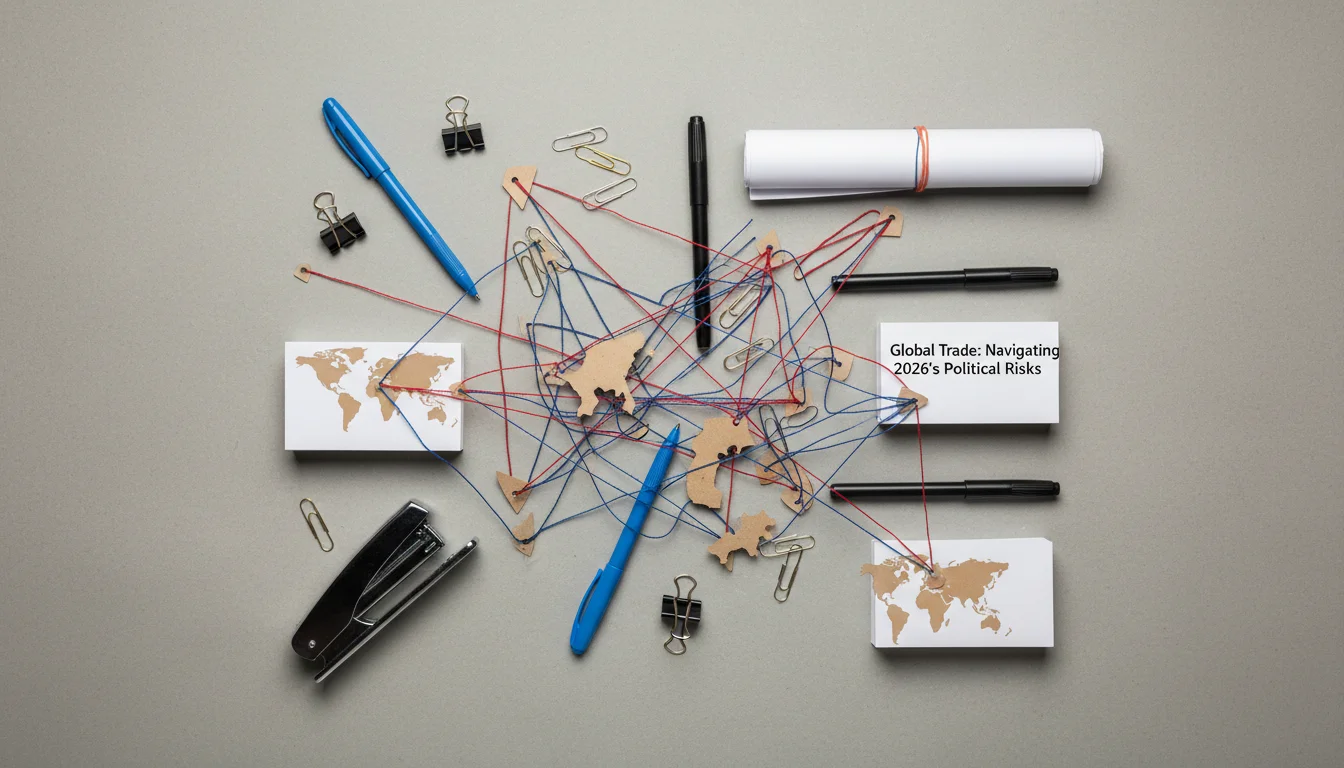
The complexities of cross-border trade in 2026 are increasingly defined by geopolitical shifts, demanding a proactive approach to political risk mitigation. Businesses working through global supply chains and expanding into new territories face a volatile field where policy changes, civil unrest, and international disputes can quickly disrupt operations and erode profitability. How can enterprises effectively safeguard their global market access and investments against these unpredictable forces?
Key Takeaways
- Geopolitical instability, including trade wars and sanctions, remains the primary driver of political risk in 2026, necessitating dynamic monitoring.
- Diversifying supply chains and market entry points reduces dependency on single regions, offering a tangible hedge against localized political disruptions.
- Strong contractual frameworks, including force majeure clauses and dispute resolution mechanisms, are essential for mitigating financial and operational exposure in high-risk environments.
- Proactive engagement with local political and economic stakeholders, alongside independent risk assessments, provides critical intelligence for informed decision-making.
ANALYSIS: The Evolving Geopolitical Risk Field in 2026
The global economic environment in 2026 is characterized by a fracturing consensus on international cooperation, leading to increased political risk for businesses engaged in international trade. We are observing a distinct trend where traditional economic alliances are being re-evaluated, and national interests are frequently prioritized over multilateral frameworks. This shift manifests in several ways, from escalating trade protectionism to the weaponization of economic sanctions. For instance, recent tariffs imposed by several nations on specific technology components, ostensibly for national security reasons, have created significant ripple effects across global manufacturing supply chains. A report from the Reuters Institute for the Study of Journalism in February 2026 highlighted that global trade fragmentation is projected to increase by an additional 15% over the next two years, primarily due to these geopolitical realignments.
The rise of digital authoritarianism also presents a unique challenge. Countries are increasingly implementing data localization laws and digital sovereignty regulations, complicating cross-border data flows and the operations of multinational tech companies. This creates a patchwork of compliance requirements that can be costly and difficult to navigate, effectively limiting market access for firms unwilling or unable to adapt. Consider the recent restrictions on cloud service providers in a major Southeast Asian economy, which mandated local data storage and processing for all government-related contracts. Such policies compel companies to invest heavily in localized infrastructure or risk losing significant market share, an investment that carries its own political risk should the policy environment change abruptly.
On top of that, the ongoing proxy conflicts and regional tensions, particularly in resource-rich areas, continue to pose direct threats to logistical routes and energy supplies. While these conflicts are often localized, their impact on global shipping lanes and commodity prices is immediate and far-reaching. The recent disruptions in maritime traffic through a critical chokepoint, for example, forced many shipping companies to re-route, adding weeks to delivery times and significantly increasing freight costs. This shows the inherent unpredictability of political risk. What begins as a localized security concern can rapidly escalate into a global economic impediment.
Strategic Diversification: A Core Tenet of Risk Mitigation
In this challenging environment, strategic diversification is not merely an option. It is a fundamental requirement for mitigating political risks. This extends beyond diversifying a product portfolio or customer base to include a deliberate strategy for supply chain resilience and market entry. Companies must actively seek multiple sourcing options for critical components and raw materials, reducing dependence on any single country or region. The vulnerability exposed during the 2020-2022 period, when reliance on single-point suppliers led to widespread shortages, is a stark reminder of this necessity. Those lessons, I believe, have not been fully absorbed by all enterprises, and we still see concentration risks in many sectors.
A truly diversified approach also involves exploring alternative manufacturing locations and distribution hubs. This might mean investing in production facilities in politically stable, yet perhaps higher-cost, regions to counterbalance operations in more volatile areas. For instance, a major electronics manufacturer recently announced plans to establish a new assembly plant in Central Europe, complementing its existing operations in East Asia. This move, while increasing initial capital expenditure, provides a critical hedge against potential trade barriers or political instability in its primary production zone, thereby securing future market access.
Plus, diversifying market entry strategies means not placing all eggs in one basket when expanding internationally. Instead of focusing solely on large, established markets, businesses should consider a portfolio approach that includes emerging markets with different geopolitical alignments and economic drivers. This could involve direct foreign investment in some regions, licensing agreements in others, and joint ventures where local expertise and political connections are paramount. The goal is to create a mosaic of international operations where the failure or disruption in one market does not cripple the entire global enterprise. This requires careful, country-specific analysis, often involving specialist consulting firms that can provide granular insights into local political dynamics and regulatory frameworks.
The Indispensable Role of Strong Contractual Frameworks
Legal and contractual safeguards are the bedrock upon which successful cross-border trade in high-risk environments is built. Without carefully drafted agreements, businesses are left exposed to the whims of political change and the potential for expropriation or contract repudiation. A critical element here is the intelligent use of force majeure clauses. These clauses, often overlooked or boilerplate, must be tailored to specifically address political events such as sanctions, embargoes, civil unrest, and government intervention that could prevent contractual obligations from being met. Simply stating “acts of God” is insufficient in 2026. Specific geopolitical risks must be enumerated.
Beyond force majeure, businesses must prioritize clear and enforceable dispute resolution mechanisms. This often means opting for international arbitration over local courts, particularly in jurisdictions with less transparent legal systems. Arbitration clauses should specify a neutral venue (e.g., London, Singapore, Geneva) and a recognized arbitration institution (e.g., ICC, LCIA, SIAC). The enforceability of arbitral awards, backed by conventions like the New York Convention, provides a far greater degree of security than relying on foreign judicial processes. I have seen firsthand how a poorly drafted arbitration clause can render a multi-million dollar contract effectively useless when political headwinds shift.
On top of that, consider the strategic use of political risk insurance. This specialized insurance can cover losses arising from events such as expropriation, currency inconvertibility, political violence, and breach of contract by a sovereign entity. While it comes at a premium, for significant investments in politically sensitive regions, it offers a vital layer of financial protection. Firms like Aon and Marsh offer complete political risk policies that can be customized to specific project needs. It’s not a substitute for proactive risk management, but rather a financial backstop that allows businesses to recover from unforeseen political events. This is especially relevant for long-term infrastructure projects or substantial foreign direct investments where the political field can evolve dramatically over decades.
Intelligence Gathering and Stakeholder Engagement
Effective political risk mitigation hinges on superior intelligence gathering and proactive engagement with a broad spectrum of stakeholders. Relying solely on publicly available news feeds is insufficient. Businesses need access to nuanced, real-time analysis of political sentiment, policy trajectories, and potential flashpoints. This often involves subscribing to specialized geopolitical intelligence services or employing dedicated in-house analysts. Firms like Stratfor or Eurasia Group provide country-specific risk assessments that go beyond surface-level reporting, offering predictive insights into political stability and regulatory changes. Understanding the subtle shifts in domestic political power, the influence of various factions, and the potential for policy reversals is paramount for maintaining market access.
Beyond passive intelligence, active stakeholder engagement is critical. This means building relationships not just with current government officials, but also with opposition parties, local community leaders, industry associations, and non-governmental organizations. These relationships provide invaluable early warning signals of impending policy changes or social unrest. For example, a company operating a manufacturing facility in a developing nation might engage with local labor unions, not merely for compliance, but to understand underlying social grievances that could escalate into broader political instability affecting operations. This proactive dialogue can also help shape policy outcomes, ensuring that business interests are considered during legislative processes.
Plus, businesses should conduct regular, independent political risk assessments, not just at the outset of an investment, but throughout its lifecycle. These assessments should be complete, covering macroeconomic indicators, governance quality, social stability, and external relations. They should also include scenario planning, envisioning various political outcomes and their potential impact on operations and profitability. This iterative process allows companies to adapt their strategies as the political field evolves, rather than reacting belatedly to crises. It’s about being prepared for multiple futures, recognizing that the only constant is change.
The imperative for businesses engaged in international trade to proactively identify, assess, and mitigate political risks has never been more pressing. By embracing strategic diversification, fortifying contractual frameworks, and investing in strong intelligence and stakeholder engagement, companies can build resilience against the unpredictable currents of global geopolitics, thereby safeguarding their market access and long-term viability.
What is political risk in the context of international trade?
Political risk refers to the likelihood that political decisions, events, or conditions in a foreign country will negatively impact the profitability or sustainability of an international business operation. This can include government expropriation, civil unrest, policy changes, trade wars, sanctions, currency restrictions, and regulatory shifts.
How do trade wars specifically impact cross-border trade?
Trade wars typically involve the imposition of tariffs, quotas, or other barriers on imported goods between countries. This increases the cost of goods, reduces consumer demand, disrupts established supply chains, and can lead to retaliatory measures, significantly hindering the flow of cross-border trade and impacting market access.
Can political risk insurance cover all types of political disruptions?
Political risk insurance provides coverage for a range of specified political events, such as expropriation, political violence, currency inconvertibility, and breach of contract by a sovereign entity. However, policies are highly customized and typically do not cover all possible political disruptions. Careful review of terms and conditions is essential to understand specific exclusions.
What is the role of international arbitration in mitigating political risk?
International arbitration provides a neutral, often more efficient, and specialized mechanism for resolving disputes between international parties, including those involving sovereign entities. By agreeing to arbitration in a neutral venue, businesses can avoid potentially biased local courts and benefit from internationally recognized enforcement mechanisms for awards, reducing political interference in legal proceedings.
Why is supply chain diversification considered a political risk mitigation strategy?
Supply chain diversification reduces a company’s reliance on a single country or region for critical inputs, manufacturing, or distribution. This strategy helps mitigate political risks by ensuring that disruptions in one geopolitical area, such as trade restrictions, natural disasters, or civil unrest, do not completely halt operations, preserving market access and operational continuity.